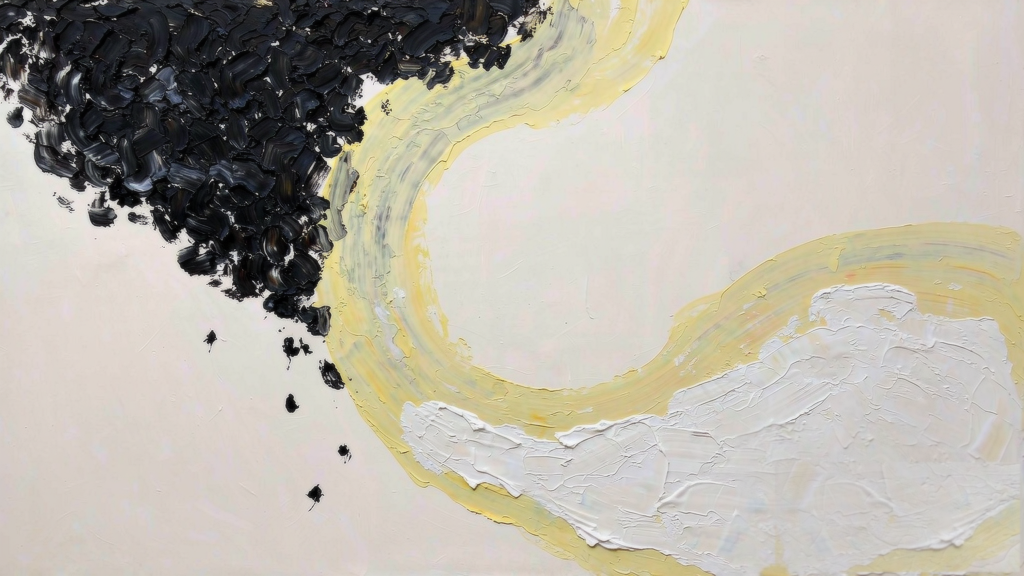
Scatter, and gather anewDispersion
Scattering is not the end; it is the beginning of regathering.
Huan is wind over water — blowing it into sheets and rings. Its subject is dispersal: the ossified must break apart, the clenched must loosen, the knotted must open. Huan is not extinction but reorganization. Every real renewal starts with a scattering — but it needs the king at the ancestral temple: a center, so that after scattering there is a shared direction to regather around.
A line: scatter your own faction — disperse the cliques too. Scattering only others and never one's own, the dispersal is not thorough. True reorganization re-sorts even your own belonging. Only when nothing can be leaned on does the new center stand firm.
Detailed reading
Hexagram 59 is wind over water: what had frozen or clumped together is being broken up and scattered.
The image behind it is simple: wind on a lake surface, breaking up a layer of ice that had held all winter.
What it gives is dissolution of the blockage — the return to flow after a stretch of rigidity. Note that this is offered, not promised.
The two trigrams
Hexagram 59, Dispersion, is built from two trigrams: Water below, which describes the inner situation you are standing in, and Wind above, which describes what the situation presents to the world. Water below is what is stuck while Wind above is what moves across it, so the dissolving force arrives from outside and above.
Water is yang held between two yin lines: strength moving through a channel, always in danger and always continuing. Its image is the ravine, which is shaped by exactly what it has to survive. As a lower trigram it means the difficulty is internal — your own habits and fears; as an upper trigram it means the danger sits in the environment.
Wind is yin beneath two yang lines: penetration rather than force. Its image is wood sending roots through soil, and air finding every gap. As a lower trigram it means gradual and largely invisible influence inside you; as an upper trigram it means the situation is being shaped by slow pressure rather than by one decision.
Read together, water sets the tone inside you while wind shapes what actually meets you outside; the distance between those two is what this hexagram asks you to hold rather than to resolve.
Where it stands in the sequence
Hexagram 59 sits at position 59 of the sixty-four. It follows Hexagram 58 · The Joyous and it is followed by Hexagram 60 · Limitation. The sequence is not a list of separate ideas — each hexagram is the consequence of the one before it, which is why the book is read as a movement rather than as a dictionary.
It follows the Joyous because sustained openness eventually loosens whatever had hardened.
How to work with Hexagram 59
The specific warning attached to this hexagram is worth taking literally. Its failure mode is dispersing the wrong thing, and scattering what you needed to keep.
What it asks of you instead is modest and concrete. Break up the one rigid arrangement that is blocking everything, and let the rest move again.
Keep the action small enough that you would still do it on a bad day.
Related hexagrams
Hexagram 59 has four natural neighbours inside the sixty-four: the two that stand next to it in the sequence, the one produced by reading its six lines in reverse, and the one produced by inverting every line. They are useful because they show the same situation from a different angle rather than describing a different situation.
- Lines reversed: Hexagram 60 · Limitation (節, Jie) — Lake below, Water above.
- Every line inverted: Hexagram 55 · Abundance (豐, Feng) — Fire below, Thunder above.
- Immediately before: Hexagram 58 · The Joyous (兌, Dui) — Lake below, Lake above.
- Its nuclear hexagram: Hexagram 27 · Mouth Corners (頤, Yi) — Thunder below, Mountain above.